PSI (Ψ) finds the subspace of a frozen language model's activations that carries a variable you
name, given only the list of answers that variable can produce. The training targets are the model's own
output distributions on random pairs of prompts, so no labels are needed.
one interchange, on a real pair of test prompts
gemma-2-2b, MCQA, layer 17, last token, soft target, rank 16, seed 11. Two test pairs
from the benchmark, each the median-KL pair of its family. The plane spans two of the subspace's 16
directions, which hold 60% of the test activations' variance inside it; the vertical
axis is the main direction of variance outside it. Each letter is one of the 200 test prompts, marked by the
option the model picks. Over 150 test pairs and three seeds, KL(q(s)∥q(hb←s)) averages
0.103 nats.
From an Answer List to a Subspace
The investigator writes the first step. The frozen model supplies everything numerical.
1.
Declare the answer list
A semantic program lists the answers the variable can produce and the rule an interchange should
follow. For the position of the correct option, the library is the prompt's own option labels and the rule
is the full swap: the base should read as the source does.
no correct answer, no annotated pair, no executable model
2.
Read the targets from the frozen model
Pair prompts at random. The model's log-probability on each declared answer, renormalised over the
library, is its reading of the variable. The target for a pair is the source's reading, so nobody writes a
counterfactual answer.
the reading q is the model's opinion about the variable
3.
Train the subspace
Learn an orthonormal basis A at one layer and token, with projector π. The
interchange keeps the base outside the subspace and takes the source inside it; training brings the
edited model's reading to the target.
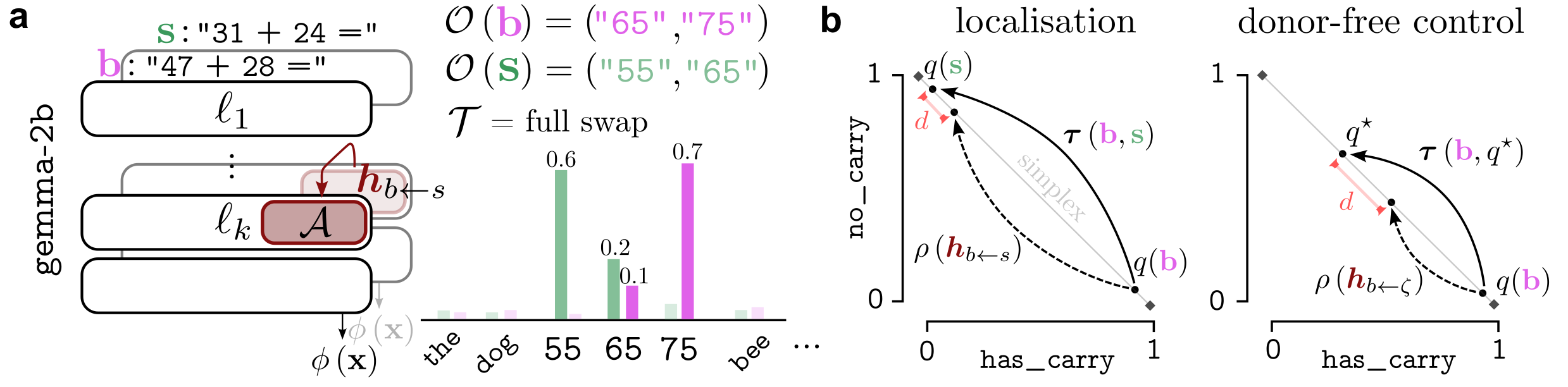
Figure 1 of the paper. (a) The declared answers and the frozen model's probability on each,
read at the layer where the subspace sits. (b) A reading is a point in the simplex over the answers. The
interchange should move the base's reading to τ(b,s), and the remaining
distance d is the training signal. The same target can be requested directly as
q⋆, with no donor.
Position or Symbol?
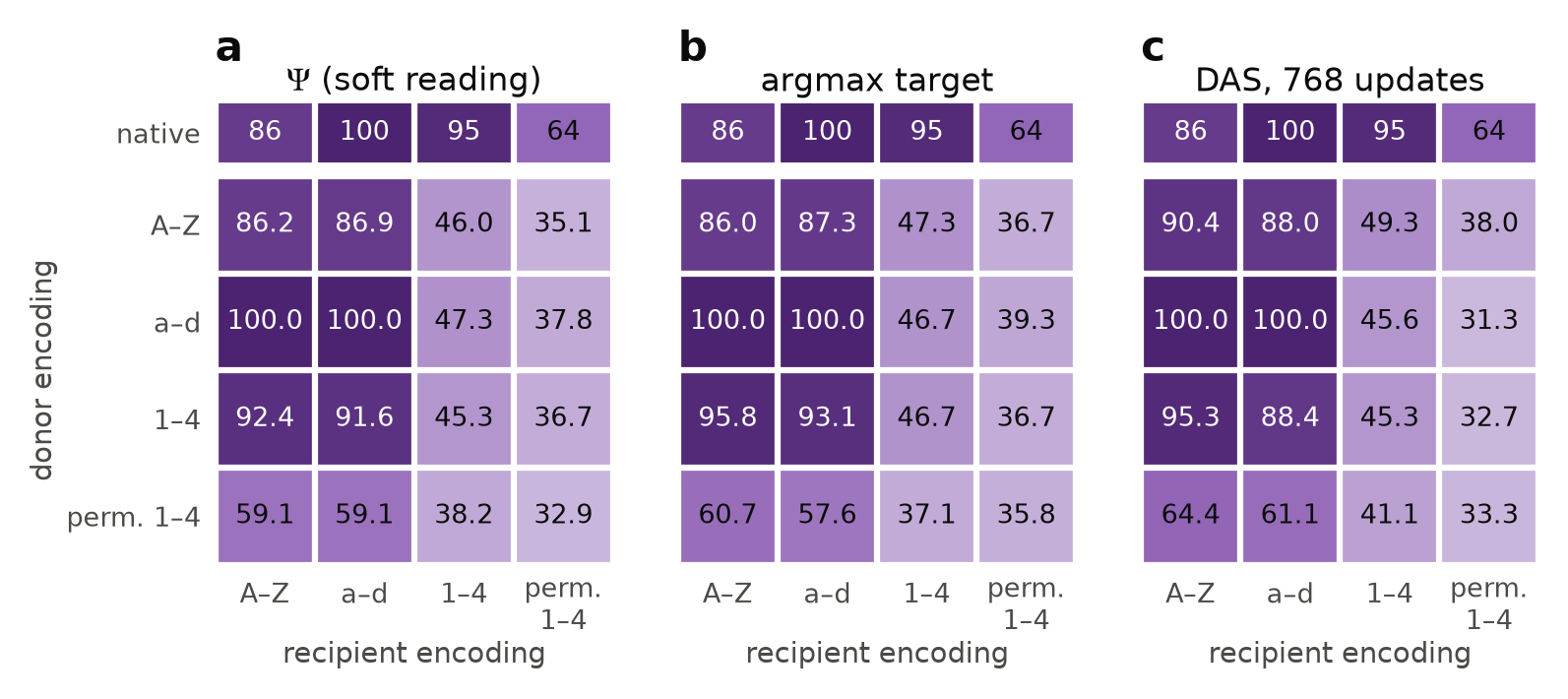
The Ψ subspace for the answer position was trained with capital-letter
labels. Frozen, it now swaps answers between prompts labelled differently. If it carries the position, the
recipient answers with its own label at the donor's position.
donor labels
recipient labels
donor ↓ recipient →
A–Z
a–d
1–4
perm. 1–4
A–Z
a–d
1–4
perm. 1–4
Ψ, mean of three seeds, % of 150 test pairs
%
of test pairs where the edited recipient answers at the donor's position, written in its own labels.
Ψ
DAS
no edit
donor s
recipient b
gemma-2-2b, layer 17, last token, rank 16. Greedy decoding,
exact case-sensitive label, 150 test pairs, unweighted mean over the three
counterfactual families.
The paper's figure, with the argmax-target and DAS subspaces beside ΨAppendix figure of the paper. Rows are donor encodings, columns recipient encodings; the strip
above each map is the unedited model's accuracy with the recipient's labels.
Key Numbers
Each value is exported from the experiments reported in the paper.
Localization at matched budget
90.24vs 91.70
Official MIB score on MCQA, Ψ against DAS, both trained for 768 updates on the same model,
layer and rank. Ψ trains on random prompt pairs, DAS on the benchmark's curated pairs. Averaged over
3 seeds, DAS gets 1.7 more of the 122 test pairs right.
No gold labels
89.34
The training targets are the model's own distributions, so Ψ can train on every prompt, including those the
model answers wrongly, with no answer key at any stage. Its official score is then 89.34.
Using gold labels to keep only correctly answered prompts adds 0.9 points.
Natural ARC questions
85.9%vs 72.1%
On the 111 held-out pairs whose donor question the model answers wrongly, the edited
recipient gives the donor's answer in 85.9% of pairs when the subspace is trained on the
model's distribution. Trained on gold labels, it does so in 72.1%.
Donor-free control
94.8%
Ψ can also be asked for an answer directly, with no donor prompt. Trained jointly with its controller, it
realizes 94.8% of held-out requests. The same controller reaches
81.7% inside a frozen DAS subspace and 34.2% inside a random
one. Swapping in a real donor reaches 87.9%.
BibTeX
If this is useful in your work, please cite
@article{muratore2026programmable,
title = {Programmable Semantic Interventions: Learning Causal Carriers from Behavioral Programs},
author = {Muratore, Paolo and Mathis, Mackenzie Weygandt},
journal = {arXiv preprint arXiv:XXXX.XXXXX},
year = {2026}
}